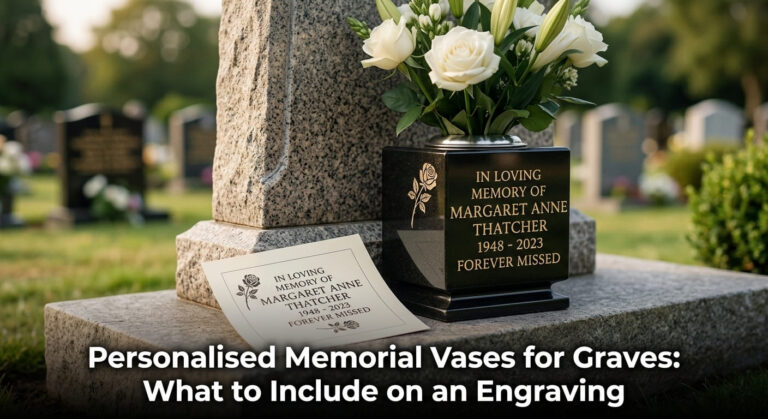
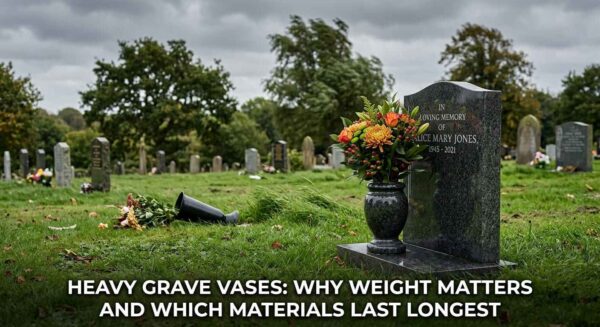
Choosing heavy grave vases is one of those decisions that most people only think about after their first arrangement has blown across the cemetery in a November gale. Weight is not a cosmetic detail; in the context of British weather, where wind speeds across exposed churchyards and open cemetery plots can easily exceed 40 mph, it is the single most important functional specification a grave vase can have.
This guide explains exactly why weight matters, what happens when a grave vase is too light, how much a vase needs to weigh to stay stable in outdoor UK conditions, and how every major material, granite, marble, bronze, aluminium, stainless steel, and plastic, performs against the specific challenges of the British climate.
Why Weight Matters in a Grave Vase
The physics are straightforward. A lightweight grave pot placed next to a headstone sits exposed to the wind on at least three sides. Wind creates an uplift force that acts across the upper surface of the vase and any flower vase for the grave it holds, pushing the arrangement sideways and, with sufficient gust force, tipping it entirely. A vase with a lower centre of gravity, achieved through mass in the base rather than height in the sides, resists this force in direct proportion to its weight.
Research into cemetery vase stability consistently points to 9–11 pounds (approximately 4–5 kg) as the practical threshold for a freestanding grave vase to remain reliably upright during typical UK wind events without being anchored to a ground spike or headstone. Above this weight, the arrangement remains stable through most British weather. Below it, as is common with lightweight plastic cone vases and some aluminium inserts, tipping becomes a recurring problem on exposed plots.
The consequences of a tipped vase are more than inconvenient. A fallen arrangement scatters flowers, can chip a headstone if it falls against it, and leaves the memorial looking untended between visits. For families who cannot visit frequently, the difference between a heavy-duty vase grave and a light one directly affects how the grave looks and feels across weeks and months.
There are two engineering solutions to the stability problem: raw material weight and design features that distribute or add weight at the base. The octagonal weighted base design, used in high-quality freestanding grave pots, works on the second principle, providing a broad footprint that resists tipping even without the mass of solid stone. Families who cannot visit regularly to check whether their arrangement has been displaced by wind benefit most from the heaviest, most stable option available.
The Six Main Grave Vase Materials: Durability, Weight, and Longevity
Granite
Granite is the benchmark material for heavy, long-lasting grave vases in the UK. As a natural igneous rock formed under extreme pressure deep within the Earth’s crust, it rates 6–7 on the Mohs hardness scale, making it resistant to scratching, chipping, and surface erosion. Polished granite vases are among the heaviest available: a standard turned granite grave vase typically weighs between 4 and 5 kg, placing it firmly in the optimal stability range.
Granite does not react to acid rain, an important consideration in UK urban and suburban cemeteries where atmospheric pollution accelerates the weathering of softer stones. Its polished surface reduces porosity to near zero, which means it sheds water efficiently and resists the freeze-thaw cycle that can crack porous materials during British winters. Granite grave vases require minimal maintenance: an occasional clean with a soft cloth, water, and a mild non-ionic detergent restores the surface to its original finish. With proper care, granite in outdoor conditions can last several centuries.
The one practical consideration with granite is that it does not lend itself easily to fine decorative carving. For families who want a vase with intricate etching or bespoke inscription panels, other materials offer more flexibility.
Marble
Marble has been used in memorial settings for thousands of years, and its cream-veined or pure white surface brings a softness and elegance that polished granite cannot fully replicate. For grave vases spike, marble is also a heavy material, typically heavier than plastic, aluminium, or resin alternatives, which contributes to stability outdoors.
Its significant weakness, particularly in the UK, is acid sensitivity. Marble is composed largely of calcium carbonate, which reacts with the mild carbonic acid formed when rainwater dissolves atmospheric carbon dioxide, and with more concentrated acid rain in industrial or urban areas. Over time, this reaction softens the surface of an outdoor marble vase, gradually obscuring inscriptions and losing the polish that gives marble its distinctive appearance. In exposed cemetery plots, this process is visibly accelerated compared to sheltered indoor settings.
Marble grave vases require more frequent maintenance than granite; periodic sealing every one to two years is recommended to slow surface weathering, and they are better suited to sheltered churchyard locations than to fully exposed open-air cemetery plots. Where aesthetics are the priority and conditions are protected, marble remains a dignified and distinctive choice.
Bronze
Bronze is arguably the most prestigious material in memorial settings. An alloy composed primarily of copper and tin, bronze has been used in outdoor monuments for thousands of years and is known for exceptional structural longevity. Its resistance to rust and corrosion makes it reliably durable in UK outdoor conditions, and it develops a distinctive greenish-brown patina as it oxidises, a natural process that many families find aesthetically appropriate for a memorial setting.
Bronze grave vases are among the most long-lived options available, with properly maintained pieces expected to last for generations. They are, however, the most expensive of the common grave vase materials, and their visible material value makes them a target for theft in some cemetery locations. Families considering a bronze cemetery name upto 20 characters vase in a high-risk location should weigh the security considerations against the material’s exceptional longevity. Optional waxing can preserve the original shine if the natural patina is not preferred.
Aluminium
A useful compromise can be seen in aluminium grave vases, which are by definition lightweight but resistant to corrosion and therefore a good and fairly inexpensive choice in the UK, to use out of doors. Aluminium has no rust, and its natural oxide coating offers some protection to the surface against moisture and exposure to the air.
The main performance consideration with aluminium in the UK climate is that coloured lids and surface finishes can fade over time under sustained UV exposure; gold and silver-coloured lid finishes, in particular, lose their brightness within a few years in direct sunlight. The structural integrity of the aluminium body itself, however, remains sound. Aluminium grave vases are manufactured in the UK and are available with removable lids in a range of finishes, making them one of the more practical and accessible choices for families on a budget who still want reliable outdoor durability.
Because aluminium is lighter than stone or bronze, it is better suited to use as a headstone insert, held in place by the surrounding stone, than as a freestanding pot, where additional weighting with pebbles or sand in the base is advisable to reach the stability threshold.
Stainless Steel
Stainless steel grave vases retain their polished surface longer than most materials in outdoor conditions, resisting rust and corrosion throughout the year. The chrome-like finish gives a contemporary rather than traditional appearance, making stainless steel a better fit for modern memorial settings than for traditional churchyards.
Its weight is comparable to aluminium, lighter than granite or bronze, so the same stability considerations apply for freestanding use. As an insert within a stone memorial or as a vase held in position by a ground spike, stainless steel performs very reliably with minimal maintenance.
Plastic
Plastic grave vases, specifically those manufactured from UV-stabilised polypropylene, are the most economical option and have a practical place in a range of memorial settings. They do not rust, are lightweight to transport, and will not shatter if knocked or dropped in the way that glass would. High-quality recycled plastic grave pots manufactured in the UK are available with gold, silver, and black lid finishes.
Their functional lifespan in outdoor UK conditions is typically four to six years before the plastic structure begins to degrade under UV exposure and temperature cycling. As freestanding pots, they require additional weighting, pebbles or bags of sand packed into the hollow base section, to approach the stability of heavier stone or metal options. They are least likely to be stolen, which is a practical advantage in some cemetery settings.
Material Comparison at a Glance
| Material | Typical weight | Acid rain resistance | Freeze-thaw resistance | Outdoor lifespan | Maintenance |
| Granite | 4–5 kg | Excellent | Excellent | Centuries | Minimal |
| Marble | 3–5 kg | Poor | Moderate | Decades (with care) | Regular sealing |
| Bronze | 2–4 kg | Excellent | Excellent | Generations | Low–moderate |
| Aluminium | 0.5–1.5 kg | Good | Good | 10–20 years | Low |
| Stainless steel | 0.5–1.5 kg | Excellent | Good | 15–25 years | Minimal |
| Plastic | 0.2–0.5 kg | Good | Good | 4–6 years | Low |
Matching Your Grave Vase to Your Memorial
The best heavy grave vase for your needs depends on three factors: the headstone type, the cemetery’s exposure, and how frequently you visit. For exposed plots with infrequent visits, granite or bronze provides the combination of self-sustaining weight and long-term durability that means the vase will still be upright and presentable between visits, without needing constant intervention.
In the case of headstone insert applications, where positional stability is assured by the surrounding stone, aluminium and stainless steel are viable options, which do not add too much weight without compromising weather protection. A UV-stabilised plastic pot with pebbles at the bottom is a good temporary solution to a family with more than one grave on a limited budget.
Always check with the specific cemetery or churchyard before purchasing, as UK burial authorities maintain varying rules on acceptable materials, sizes, and whether freestanding vases are permitted. Some local authority cemeteries restrict decorative materials to those that do not obstruct groundskeeper access.
At Signs and Memorials, the grave vase range includes options across all the main material types described above, from polished granite vases matched to headstone finishes through to heavy-duty aluminium inserts, all designed and tested for UK outdoor conditions.
Frequently Asked Questions
Q1. Why does my grave vase keep blowing over?
Lightweight grave vases, particularly plastic cone styles, lack the base weight to resist wind uplift in exposed UK cemetery plots. A stable outdoor grave vase should weigh approximately 9–11 pounds (4–5 kg). Adding pebbles or sand to a hollow base significantly improves stability without replacing the vase.
Q2. What is the most durable material for a grave vase in the UK?
Granite is the most durable material for a heavy grave vase in the UK. It resists acid rain, frost, UV exposure, and surface erosion with minimal maintenance. A granite grave vase can last for centuries outdoors. Bronze is the second most durable choice, particularly suited to heritage and traditional memorial settings.
Q3. How heavy should a grave vase be to stay stable outdoors?
The minimum weight of a free standing grave vase is 9-11 pounds (4-5 kg) to avoid overturning under normal UK wind conditions. Heavier granite and bronze vases meet this threshold naturally. Lighter aluminium or plastic vases can reach it by adding internal weighting, pebbles, or sand packed into the base section.
Q4. Does granite last longer than bronze for a cemetery vase?
Both granite and bronze are exceptionally long-lasting grave vase materials. Granite can endure for centuries without degrading, while bronze develops a natural patina but remains structurally sound for generations. Granite requires less maintenance; bronze offers greater design detail. Signs and Memorials supplies both in finishes suited to UK cemetery conditions.
Q5. How long does a plastic grave vase last outdoors?
A UV-stabilised polypropylene plastic grave vase typically lasts four to six years in UK outdoor conditions before the structure begins to degrade. Standard decorative plastic deteriorates faster. The recycled plastic grave pots produced in the UK are of high quality and have a competitive edge over those imported in the UK and there are a range of lid colours and finishes.
Q6. Is marble a good material for a grave vase in the UK?
Marble is aesthetically distinctive but less suited to fully exposed UK cemetery plots. Its calcium carbonate composition reacts with acid rain, gradually softening the surface and obscuring inscriptions over time. In sheltered churchyards, a marble grave vase can last decades with periodic sealing. For exposed plots, granite performs significantly better.
Q7. What is the difference between a heavy grave vase and a standard grave vase?
A natural wind resistant vase is a heavy, usually granite, stone or bronze, vase, which offers wind resistance by its weight, and does not require further anchoring in the outdoor UK climate. A standard lightweight vase relies on a ground spike or headstone insert for stability. Signs and Memorials offer heavy grave vases designed to stand securely as freestanding memorial tributes.