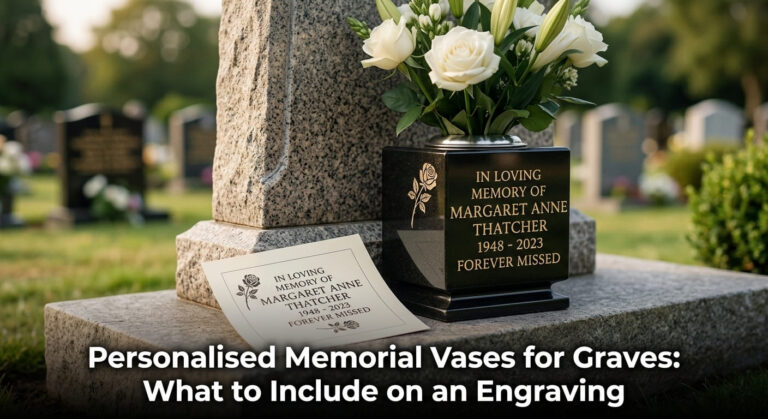


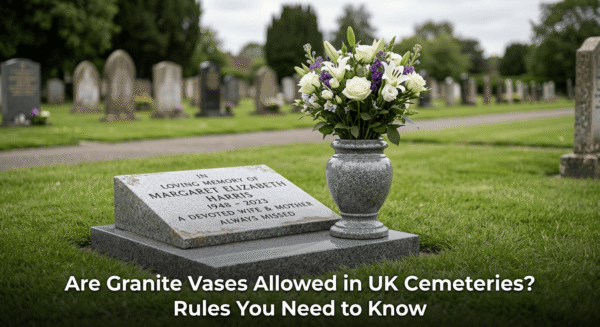
The short answer is yes, granite memorial vases for graves are accepted in the vast majority of UK cemeteries. But “UK cemeteries” is not a single, uniform category. The rules that govern what you can place at a grave depend entirely on what type of burial ground you are dealing with, and the distinctions matter far more than most families realise before purchasing a memorial vase.
This guide explains exactly how cemetery vase regulations work in the UK, what legislation applies, what the most common restrictions look like in practice, and the specific steps needed to ensure your granite vase complies with your cemetery’s requirements before you buy or install anything.
Burial grounds in England and Wales are governed by two entirely different legal frameworks, depending on whether the site is a churchyard or a civil cemetery.
Local authority and civil cemeteries are governed primarily by the Local Authorities Cemeteries Order 1977 (LACO), made under the Local Government Act 1972. LACO sets out the statutory framework for how cemeteries must be managed and what families are permitted to do with burial plots. Under LACO, each cemetery operator, typically a local council or private operator, publishes its own rules and regulations that sit within this statutory framework. This is why the specific rules you encounter vary between councils while sharing a common structure.
Church of England churchyards operate under an entirely separate system: ecclesiastical law governed by the Faculty Jurisdiction Rules 2015. The Diocesan Chancellor grants approval for memorials in a churchyard through the faculty jurisdiction process. A parish priest can approve standard memorial types that comply with a diocese’s published guidelines as “List B matters,” without requiring a full faculty application. In May 2024, Additional Matters Orders came into force under the Church of England Miscellaneous Provisions Measure 2024, which expanded the range of memorials that incumbents can permit without a full faculty, but each Diocese still sets its own detailed guidelines.
The practical consequence: a granite memorial vase that is straightforwardly permitted in a local authority cemetery may face restrictions in a Church of England churchyard, depending on the Diocese. Always check which type of burial ground you are dealing with before purchasing.
In local authority cemeteries across the UK, councils widely accept granite for memorial vases. Many councils explicitly state in their published regulations that memorials must use naturally quarried materials of durable, sound quality, and they list granite, marble, and slate as acceptable options. They typically exclude artificial stone and soft stone. They also almost universally prohibit glass jars and bottles for safety reasons, as broken glass can injure groundskeeping staff and visitors.
Granite’s status as the benchmark acceptable material for cemetery memorials is directly tied to its physical properties; it is hard, non-reactive to acid rain, non-porous when polished, and does not degrade in ways that would make it unsafe or unsightly over time.
In Church of England churchyards, granite as a material is generally accepted, but there is a specific nuance that families are frequently unaware of: many Church of England dioceses prohibit polished black granite in particular, even though other colours and finishes of granite may be permitted. This restriction stems from aesthetic policies that some dioceses maintain around uniformity and the traditional appearance of churchyards. Standard grey or other granite finishes are more widely accepted in churchyards than polished black. If you are considering a Shanxi Black or other highly polished dark granite vase for a churchyard plot, confirming with the relevant Diocese before purchase is strongly advisable.
Even where granite memorial vases are permitted, cemeteries apply specific restrictions on their dimensions and positioning. These vary by council and cemetery section, but the following patterns appear consistently across published UK cemetery regulations.
Height limits: Most councils specify a maximum height for separate flower vases placed on graves. Manchester City Council regulations specify a maximum vase height of 30 centimetres. The BCP Council (Bournemouth, Christchurch and Poole) regulations specify that vases must not exceed 200mm in height, 250mm in width, and 250mm in depth. Other councils apply similar limits; always check your specific cemetery’s published regulations or call the cemetery office directly.
Placement at the head of the grave: A near-universal requirement across UK council cemeteries is that vases must be placed at the head of the grave and positioned so that they do not prevent groundskeeping staff from mowing the grass. Vases placed outside the headstone base footprint or in the middle of a grassed area are routinely removed without prior notice. The standard footprint permitted is typically defined as the area directly around the headstone base, commonly cited as 36 inches by 18 inches (approximately 90cm × 45cm).
Integral vases with drain holes: Where a granite vase is built into a memorial base rather than placed separately, many cemetery regulations and Church of England churchyard guidance specifically require drain holes to be present. This addresses a practical safety concern: without drainage, water collects inside the vase body, freezes during winter, and can crack the stone from within. This is a relevant purchasing detail, ensure any integral granite vase includes a drainage hole, particularly in stone-to-stone installations.
Cemetery vase regulations vary significantly between different sections of the same cemetery, and this catches many families off-guard.
Lawn sections typically have the most restrictive rules. Many UK cemeteries do not permit flower holders, jars, or vases on the grassed area of lawn graves; they allow memorials only within the defined headstone base area. Where cemeteries permit vases, they require them to fit within the headstone base footprint. In lawn sections, cemeteries usually prohibit kerb sets, which would allow a larger memorial area, to maintain the uniform appearance that council groundskeepers need for mowing access.
Traditional sections generally allow more flexibility, including the placement of separate freestanding vases alongside kerbed memorial areas, subject to size and material requirements.
Cremated remains plots and garden of remembrance sections are subject to their own specific rules. Reading Borough Council regulations, for example, permit cremated remains wedge tablet graves to have sunken flower vases, but no other memorial items are permitted on or near these graves. Garden of Remembrance vase blocks may have specific, defined dimensions set by the cemetery.
Woodland burial areas are almost universally restricted from all memorials plaques, vases, and personal items, as the ecological management of these areas requires the ground to remain undisturbed.
Public graves, those where no exclusive right of burial has been purchased, do not permit any individual memorial, vase, or decoration. Only plots where a deed of exclusive right of burial has been granted allow the grave owner to apply for memorial permission.
For permanently installed or integral granite vases, those fixed to a headstone base or installed as part of a larger memorial, a permit is almost always required. The permit process involves submitting a memorial application form to the cemetery’s bereavement services office, with details of the dimensions, materials, and proposed installation. The permit must be approved before any work begins. Carrying out installation without a permit can result in the cemetery demanding removal at the grave owner’s expense.
Most local authority cemeteries charge a memorial permit fee, which typically ranges from £50 to £200 depending on the council. This fee is separate from the cost of the vase itself.
Installation must comply with current NAMM (National Association of Monumental Masons) and BRAMM (British Register of Accredited Memorial Masons) standards. These organisations publish the Code of Working Practice and the BRAMM Blue Book. They set out how to design, anchor, and install memorials safely. Many UK cemeteries require installers to hold a current BRAMM or RQMF (Register of Qualified Memorial Fixers) licence. BS 8415:2018 provides the main standard for memorial construction in burial grounds. It defines specifications for memorials in burial grounds and memorial sites.
For freestanding, non-fixed granite vases placed at the graveside as a separate item from the permanent memorial, permit requirements vary. Some cemeteries treat these as personal items that can be placed without formal approval (subject to size and material limits), while others require all vases to be registered with the office. Checking with the cemetery office before installation is always the safest approach.
Before purchasing any granite memorial vase for graves in the UK, work through the following:
At Signs and Memorials, every granite memorial vase in the range is manufactured from naturally quarried, durable granite that meets the material specifications required by UK local authority cemeteries. The team can also advise on common specification requirements. They help customers confirm compliance with their cemetery’s specific rules before ordering. Browse the range or get in touch at signsandmemorials.co.uk.
Yes. The published regulations of most UK local authority cemeteries explicitly list granite as an accepted material. Most Church of England churchyards also accept granite. However, some dioceses restrict polished black granite finishes. Always confirm the rules with your specific burial authority before purchasing.
For permanently installed vases fixed to a memorial, a permit from the burial authority is almost always required under the Local Authorities Cemeteries Order 1977. For freestanding vases, requirements vary by cemetery. Contact the cemetery office before installation. Unauthorised memorials can be removed at the grave owner’s expense.
Vase size restrictions vary by cemetery. Manchester City Council limits separate vases to 30cm high; BCP Council limits are 200mm high and 250mm wide. Most councils require vases to sit within the headstone base footprint and not obstruct mowing. Always check your specific cemetery’s published regulations or contact the bereavement services office.
Yes. Under the Local Authorities Cemeteries Order 1977, UK cemeteries can remove any non-compliant item without prior notice. They can also remove items that present a safety risk or interfere with grounds maintenance. Ensuring your vase complies with published size, material, and placement rules is the only reliable protection against removal.
Granite as a material is generally accepted in Church of England churchyards, but individual Dioceses set their own guidelines. Some prohibit polished black granite specifically. All memorials in a churchyard require approval through the faculty jurisdiction process. Contact the Diocese or parish priest before purchasing any memorial vase for a churchyard plot.
Local councils administer local authority cemeteries under the Local Authorities Cemeteries Order 1977. Ecclesiastical faculty jurisdiction law governs Church of England churchyards, and each diocese publishes its own guidelines. Churchyards generally have stricter material and aesthetic restrictions. Signs and Memorials can advise on compliance for both settings.
No. Glass jars, bottles, and vases are prohibited in the great majority of UK cemeteries. Cemetery regulations consistently ban glass containers on safety grounds, as broken glass presents a risk to groundskeeping staff and visitors. Granite, stone, aluminium, and approved plastic vases are the compliant alternatives in most UK burial grounds.
share this post:
