
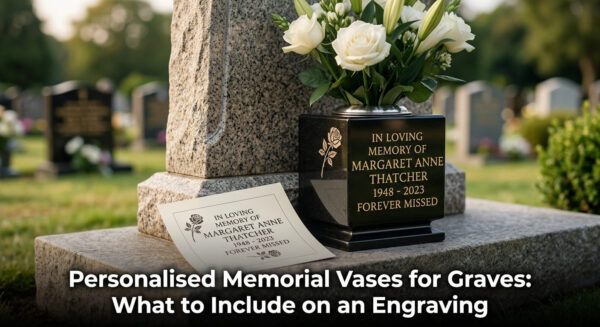
Choosing what to engrave on a personalised memorial vase for a grave is one of those decisions that is simultaneously deeply personal and practically quite constrained. You have a limited surface, outdoor weather conditions that will test the material, and words that will stand at a loved one’s resting place for years or decades. Getting it right matters, both as a tribute and as a lasting physical object.
This guide covers every element you might want to include on a grave vase engraving, from the opening phrase and name format through to symbolic motifs and the technical steps involved in placing your order safely.
The Six Layers of a Memorial Vase Inscription
A well-crafted engraving on a memorial vase typically works through a hierarchy of six content layers. You do not need to include all six; in fact, restraint often produces the most dignified result, but understanding each layer helps you decide what matters most for your specific tribute.
Layer 1: The Opening Phrase
The opening phrase sets the tone for everything that follows. In the UK, “In Loving Memory of” remains the most widely used opening for any grave inscription, but there are many alternatives that better suit different personal styles and relationships.
Common opening phrases:
- In Loving Memory of
- In Memory of
- In Memoriam
- Dearly Loved
- Forever Remembered
- Ever Loved
- In Treasured Memory of
- To the Memory of
- Fondly Remembered
- Lovingly Remembered
If you want something slightly less formal, phrases like “Always in our hearts” or “Never forgotten” can function as an opening as well as a closing phrase. For a child’s memorial, “Our precious little one” or “Tiny but forever loved” carries a different but equally meaningful tone.
The opening phrase should feel natural to say aloud. If you would not say it in conversation when speaking about the person, it may not be the right phrase for a memorial vase that family and friends will read for years.
Layer 2: The Name
How the name appears on an engraved grave vase affects how familiar or formal the tribute feels, and this is very much a personal choice.
Approaches to naming:
- Full formal name, used where dignity and permanence are the priority: Elizabeth Jane Thompson
- Common shortened name, used when the formal name was rarely used: Liz Thompson
- Familiar or relational name, used when the relationship is as important as the name itself: Nan, Grandad, Dad, Mum, Gran
- First name only, appropriate for smaller vases with limited engraving space, or where the family is the primary audience
Where a nickname was the name everyone used, there is no reason to default to the legal name simply because it feels more official. A grave vase is a personal tribute, and “Nan” may carry more emotional weight than “Patricia.”
Layer 3: The Dates
Dates are usually the most straightforward element, but the format still deserves thought.
Common date formats for a memorial vase:
- Full dates: 17th July 1943 – 12th November 2023
- Month and year: July 1943 – November 2023
- Year range only: 1943 – 2023 (cleaner on smaller surfaces)
- Age at death: Age 80 (used when the exact dates are less significant than the period of life)
- Year of death only: 2023 (sometimes used where space is minimal, and the birth date is less relevant)
For children and infants, including months rather than years alone gives a more complete and respectful picture: 12th March 2021 – 4th September 2021.
If you are ordering a vase for a plot that may eventually commemorate more than one person, leaving space for a future date is worth discussing with the supplier at the proof stage.
Layer 4: The Relationship Descriptor
A brief relationship phrase placed beneath the name or dates gives context to anyone who visits the memorial and personalises the tribute without requiring many words.
Common relationship descriptor examples:
- Beloved wife and mother
- Devoted husband and father
- Cherished grandmother
- Much-loved grandad
- Beloved son
- Adored daughter
- A wonderful friend to all
- Loving brother and uncle
- Dear sister and aunt
- Much-loved mum, always remembered
The relationship descriptor is where the connection between the living and the deceased is most directly expressed. Choose a language that reflects how the person was known, not simply what their formal family role was.
Layer 5: The Epitaph, Quote, Verse, or Personal Words
The epitaph is the most individual element of a memorial vase engraving. It can be a famous quote, a line from a poem or hymn, a personal phrase that meant something to the person being remembered, or original words from the family.
Short quotes and phrases for a grave vase:
- Forever in our hearts
- Always in our thoughts
- Loved beyond words, missed beyond measure
- Until we meet again
- Gone but never forgotten
- Those we love don’t go away, they walk beside us every day
- Not gone, just gone ahead
- Too well-loved to ever be forgotten
- Always with us, forever in our hearts
- Quietly remembered every day
- A life well lived and greatly loved
- In our hearts forever
- The memories we keep are the lives we have shared
Poem lines commonly engraved on memorial vases:
- Do not stand at my grave and weep, I am not there, I do not sleep, from the poem by Mary Elizabeth Frye. This remains one of the most requested memorial inscriptions across the UK
- They flash upon that inward eye, which is the bliss of solitude, Wordsworth
- Step softly, a dream lies buried here, Yeats
- Death is not the extinguishing of a light, but the putting out of the lamp because the dawn has come, Tagore
Scripture and religious verses:
- The Lord is my shepherd (Psalm 23)
- I am the resurrection and the life (John 11:25)
- I am the way, and the truth, and the life (John 14:6)
- Well done, good and faithful servant (Matthew 25:21)
- To Allah we belong, and to Him we shall return (Quran 2:156), used in Islamic memorial inscriptions
Personal and original phrases: Many families find that the most meaningful epitaph is one they wrote themselves, a phrase the person used, something they believed in, or simply the truest thing about them. Give me the beat boys and free my soul, a song lyric, is genuinely engraved on headstones in the UK. No rule says an epitaph must be solemn if the person was not.
Layer 6: The Closing Phrase
A closing phrase is optional but often rounds off the inscription with emotional warmth. Common choices include:
- Always in our hearts
- Remembered with love
- Forever loved, forever remembered
- Rest in peace
- Peaceful at last
- In God’s care
- Asleep in Jesus
- At peace at last
- With the angels now
Choosing a Motif or Symbolic Image
Many personalised memorial vases for graves can be engraved with a symbolic image alongside the text. Motifs add visual meaning without adding words, and a single well-chosen symbol often communicates more than several lines of text.
Common motifs for grave vase engravings:
- Rose, love, beauty, and remembrance; the most widely requested
- Dove, peace, and the soul’s journey
- Angel, divine protection, and spiritual comfort
- Praying hands, faith, and devotion
- Cross (or Celtic cross), Christian faith, and eternal life
- Baby footprints are typically used for infant and child memorials
- Ivy leaf, fidelity, and eternal life
- Butterfly, transformation, and the soul
- Robin, a bird strongly associated with remembrance in UK culture
The guiding principle for motif selection is restraint: one symbol that truly fits reads more elegantly than multiple competing images. Treat the motif as a visual subtitle, not a decoration list.
Engraving Techniques: What to Know Before You Order
The quality and longevity of an engraved grave vase depend as much on the technique used as on the words chosen.
Sandblast engraving cuts into the stone surface under pressure, creating a three-dimensional incised channel. This is the most durable outdoor engraving method; the depth of the cut means the lettering remains clear even as surface weathering occurs over the years. Sandblast channels are subsequently painted by hand in your chosen infill colour: gold, silver, white, or black enamel.
Laser engraving uses a computer-controlled beam to create a precise, crisp finish. It is particularly suited to fine detail, photographic imagery, and complex motifs where hand-cutting would struggle with resolution.
Gold infill lettering, including 23.5 carat gold leaf, remains the most traditional and prestigious choice for outdoor memorial inscriptions in the UK. It is warm and highly visible against polished granite or slate. Note that enamel infills of any colour will gradually require maintenance over the years of outdoor exposure; this is a normal part of caring for an engraved memorial.
Font choice matters more than most buyers realise. Roman fonts, clean, upright letterforms, are the most legible on stone and tend to age better than highly stylised scripts. Script fonts can look beautiful in a design proof, but become harder to read at a distance and over time as weathering progresses.
The Proof Approval Process
Every reputable supplier of personalised memorial vases for graves will issue a digital proof image before any cutting or engraving begins. This is your opportunity to check every element before it becomes permanent.
Before approving a proof, work through the following:
- Every name spelled exactly as intended, including any unusual spellings
- All dates checked against a calendar, confirm both the year of birth and the year of death
- The date format consistent with how you want it displayed
- All lines of text fitting naturally within the allocated space
- The chosen motif and its position on the face
- The font and infill colour match your selection
Once you confirm the proof, changes typically cannot be made. Personalised memorial plaques are non-returnable after proof approval because the engraving cannot be reversed. Take as much time as you need at this stage; there is no rushing a decision of this kind.
Cemetery Regulations and What Is Permitted
In non-religious municipal cemeteries, there are generally no restrictions on the wording of a memorial vase inscription, provided it contains no offensive language. Church of England churchyards apply stricter guidelines; each Diocese sets its own rules on acceptable wording and imagery, and inscriptions should be “seemly and reverent.” If you are uncertain whether a specific phrase or motif will be approved in a churchyard, ask the parish council or Diocesan office before ordering.
Special Cases: Children and Pet Memorials
For a child’s memorial vase, including months in the date, choosing gentle opening phrases, and selecting soft motifs (butterfly, baby footprints, angel, robin) creates an inscription that reflects the brevity and tenderness of the life being remembered. Many families choose original words over traditional phrases for a child’s memorial, something specific to who that child was.
For a pet memorial vase, simpler wording is usually the most fitting: the pet’s name, the years they were with you, and a short phrase that reflects the bond: Best friend, always, Loyal, loving, missed, Run free now, or simply Good dog. Good girl. Good boy. Signs and Memorials can engrave personalised pet memorial vases with the same care and outdoor-quality craftsmanship as any other grave vase in the range.
A Final Thought on Length
The most enduring memorial inscriptions tend to be shorter than families initially expect to need. A single sentence that is completely true of the person being remembered will outlast several paragraphs of borrowed sentiment. Choose what is most specific to your loved one over what sounds most impressive, and the engraving will remain meaningful to everyone who reads it for as long as the stone stands.
At Signs and Memorials, all personalised grave vases are crafted with outdoor-grade engraving and a proof approval process that gives you full control over every detail before production begins. Browse the personalised range or contact the team directly at signsandmemorials.co.uk.
Frequently Asked Questions
Q1. What do you put on a personalised memorial vase?
A personalised memorial vase typically includes an opening phrase (such as “In Loving Memory”), the full name or familiar name, dates of birth and death, a relationship descriptor, a short epitaph or quote, and optionally a symbolic motif such as a rose or dove. Include what feels most specific and true to your loved one.
Q2. What is a good quote for a memorial vase?
Popular quotes for engraved grave vases include “Forever in our hearts,” “Those we love don’t go away, they walk beside us every day,” and lines from the poem “Do Not Stand at My Grave and Weep” by Mary Elizabeth Frye. Scripture references like Psalm 23 or John 11:25 are also widely used for faith-based memorials.
Q3. What should I put on a memorial vase engraving?
1Start with an opening line, the name in the form most meaningful to you, the dates, a relationship phrase such as “beloved wife and mother,” and a short closing epitaph. Add a symbolic motif if the vase allows it. Signs and Memorials provides a digital proof image for review before any engraving begins.
Q4. How many characters can you fit on a memorial vase?
A standard engraving face on a memorial grave vase accommodates approximately seven lines of 20–25 characters per line, depending on font size and the dimensions of the vase. Larger vases allow more text; smaller resin or plastic pots may allow as few as three to four lines. Check the specific product’s character limits before writing your inscription.
Q5. Can you put a poem on a grave vase in the UK?
Yes. Poem lines and hymn verses are among the most popular choices for memorial vase engravings in the UK. Popular options include lines from “Do Not Stand at My Grave and Weep,” Wordsworth, and Tagore. In Church of England churchyards, the wording must be seemly and reverent; check with the Diocese or parish council before ordering if in doubt.
Q6. What font is best for engraving a memorial vase?
Roman fonts, clean, upright, traditional letterforms, are the most legible and durable choice for outdoor stone engraving on a grave vase. Highly stylised script fonts can look beautiful in a proof image, but become harder to read at a distance and over time as weathering progresses. Signs and Memorials can advise on font options best suited to the material and surface size.
Q7. Can I include a motif on an engraved memorial vase?
Yes. Many personalised memorial vases for graves can be engraved with a symbolic image alongside the text; roses, doves, angels, Celtic crosses, praying hands, and baby footprints are among the most popular choices in the UK. One well-chosen motif reads more elegantly than multiple competing symbols. Discuss your preferred image at the proof stage before production begins.

