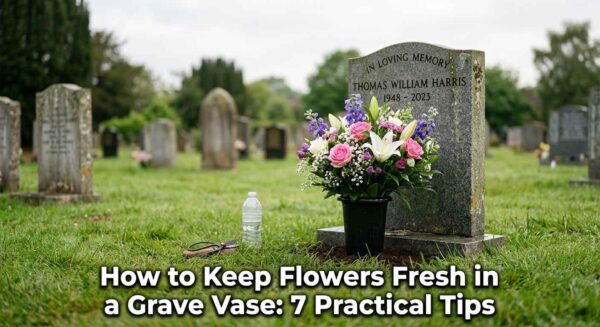
Placing fresh flowers in a flower vase for a grave is one of the most meaningful ways to tend to a loved one’s memorial plaque. But anyone who has visited a few days later to find wilted, browning stems will know how quickly the outdoors can shorten a flower’s life. Wind, sun, frost, heat, and the simple absence of regular water all work against you.
The good news is that with a handful of practical techniques, you can significantly extend how long cut flowers look their best at a graveside. These seven tips are grounded in the same principles that professional florists use and are adapted specifically for the outdoor conditions found in UK cemeteries and churchyards.
Why Do Grave Flowers Die So Quickly?
Before the tips, it helps to understand the science. When a stem is cut from its plant, it relies entirely on capillary action to draw water upward to the blooms. Any blockage, caused by bacteria in stagnant water, a stem sealed flat against a surface, or air entering the cut, stops this process, and the flower wilts from dehydration rather than old age.
Outdoors, the problem is compounded. Sunlight speeds up the flowers’ metabolic rate. Wind pulls moisture from petals faster than stems can replace it. Ethylene gas, produced naturally by decaying plant material and ripening vegetation, accelerates petal drop. And unlike an indoor vase that you pass daily, a grave vase may go unattended for several days between visits.
Understanding this makes the tips below far more intuitive.
Tip 1: Use Soaked Floral Foam Instead of Water Alone
Placing cut stems loosely in water is the most common mistake made at a graveside. Without support, stems shift in the wind, expose their cut ends to air, and allow water to evaporate quickly from the open vase.
Soaked floral foam, sometimes called oasis foam, is the single most effective upgrade you can make. Here is how to use it correctly:
Step 1: Cut a block or cylinder of wet floral foam to fit snugly inside your grave vase or grave pot. It should sit flush with or slightly below the rim.
Step 2: Submerge the foam block in cold water and allow it to absorb water fully by gravity; do not push it down, as this traps air pockets. Wait until it sinks on its own (typically two to three minutes).
Step 3: Insert trimmed flower stems directly into the soaked foam at slight angles, distributing them evenly. The foam holds each stem in position and maintains continuous moisture at the cut end.
Step 4: Ensure the foam remains moist on every subsequent visit. Top it up with water, or replace it entirely if it starts to crumble or smell stale.
Floral foam lasts approximately five to seven days before needing replacement in typical UK outdoor conditions. Styrofoam or polystyrene, by contrast, holds no water but provides excellent structural support for artificial or silk flowers.
Tip 2: Cut Stems at a 45-Degree Angle Before Placing
This step takes ten seconds and can meaningfully extend the life of any flower in a grave vase. A straight-across cut allows the stem to sit flat against the base of the foam or vase floor, blocking the opening. An angled cut of approximately 45 degrees does two things: it increases the surface area exposed to water, and it prevents the stem from sealing shut.
Use sharp scissors, garden shears, or a clean floral knife; blunt tools crush the stem’s vascular tissue, restricting water uptake in the same way a blocked artery restricts blood flow. For roses specifically, cut stems underwater where possible, as these varieties are prone to drawing air into the stem the moment they leave the water.
Tip 3: Remove All Foliage That Falls Below the Waterline
Any leaves, petals, or plant material sitting in water will begin to rot within 24 to 48 hours in outdoor temperatures. This rotting plant matter is the primary source of bacteria in your grave vase, and once bacteria multiply in the water, they clog the stem’s vascular channels, and the flower collapses from the inside.
Before placing any stems, strip off all leaves that would sit below the surface of the water or foam. This one step, more than almost any other, extends the freshness of an arrangement by several days.
Tip 4: Apply an Anti-Transpirant Preservation Spray
An anti-transpirant spray is a clear, water-based coating applied directly to flowers and foliage before or after arrangement. Originally developed for use at outdoor events and weddings, it works by forming a fine polymer layer across the petal surface that reduces the rate of moisture loss, the same mechanism that causes flowers to wilt when wind or heat pulls water from petals faster than stems can replace it.
For a grave vase, the application is straightforward: lightly mist the flower heads and foliage, covering the top and underside of petals, and allow to dry for a minute before placing the arrangement in the vase. This is particularly valuable during British winters, when cold winds accelerate moisture loss from exposed blooms, and during summer heatwaves, when high temperatures intensify evaporation.
High-quality anti-transpirant sprays are available from florist supply stockists and are odourless, non-staining, and environmentally safe. They are not branded substitutes but a standard professional tool, and one that most casual graveside visitors are entirely unaware of.
Tip 5: Choose Flowers Known for Their Longevity
The variety of flowers you choose has a greater impact on longevity than almost any care technique. These are the cut flowers with the longest confirmed vase life under outdoor UK conditions:
- Chrysanthemums — can last up to four weeks with proper water access; the benchmark for long-lived cut flowers at gravesides
- Carnations — typically 10–14 days outdoors; exceptionally robust in cool, damp British weather
- Alstroemeria (Peruvian lily) — up to two weeks; resilient, multi-headed, and available in a wide colour range
- Lavender — holds its structure long after fresh petals fade; fragrant and meaningful for a memorial setting
- Freesias — one to two weeks; excellent cold-weather performance
Avoid highly fragile varieties like tulips, daffodils, and poppies for long-term grave vase arrangements unless you visit very frequently. Where visits are infrequent, locally grown, in-season flowers will always outlast imported varieties; they have not spent days in transit and arrive with their cellular structure intact.
For winter specifically, potted plants are often more practical than cut flowers. Winter heather, pansies, cyclamen, hellebores, and snowdrops all tolerate UK frost and can sit in a grave pot for several weeks with minimal attention.
Tip 6: Use Water Tubes for Individual Stems
Water tubes, small, water-filled plastic phials that fit over individual flower stems, are a professional florist’s solution for keeping flowers hydrated without a conventional vase. They are particularly useful when you want to add a few fresh stems to an existing arrangement without replacing the entire display.
Each tube holds a small amount of water in direct contact with the stem’s cut end, extending hydration for two to four days. They are available from florist suppliers in small packs and are reusable between visits. For a cemetery vase arrangement with a mixture of fast and slow-fading flowers, topping up fresh stems in water tubes lets you maintain a full, vibrant display without dismantling the whole arrangement each time.
Tip 7: Top Up or Replace Water on Every Visit
If you are using a traditional open grave vase or a vase insert with a water reservoir, check and top up the water level on every cemetery visit. Evaporation in warm weather and absorption by stems both reduce the water level faster than most people expect, a small grave vase in direct sun can lose most of its water within 48 hours in summer.
On each visit, pour out any cloudy or discoloured water and replace it with fresh, clean water. Remove any blooms that are past their best, as dying flowers release ethylene gas that accelerates wilting in nearby healthy blooms. This is not sentiment; it is chemistry, and removing spent flowers is consistently the single simplest way to extend the life of the flowers that remain.
Seasonal Grave Flower Care at a Glance
| Season | Main challenge | Recommended approach |
| Spring | Rain saturation, wind | Use soaked floral foam; choose carnations or alstroemeria |
| Summer | Heat and evaporation | Water daily if possible; apply anti-transpirant spray; use shade-tolerant flowers |
| Autumn | Wind and shorter light | Choose chrysanthemums; trim stems weekly |
| Winter | Frost and cold winds | Use potted heather, pansies, or hellebores; apply preservation spray to cut flowers |
Fresh, Artificial, or Potted: A Practical Note
Fresh flowers will always bring the most immediate beauty to a grave vase. Artificial silk flowers, specifically those rated for outdoor or UV-resistant use, are the most practical choice when regular visits are not possible, as quality arrangements can maintain their appearance for a year or more without water or maintenance. A potted plant is the best long-term option for those who tend to a grave regularly through the seasons.
At Signs and Memorials, you will find a range of grave vases, grave pots, and memorial flower holders suited to all three approaches, designed for UK outdoor conditions and compatible with both fresh and artificial arrangements.
Whatever you choose, the seven tips above apply universally to any cut flower placed in a cemetery vase. The fundamentals are the same: clean water, supported stems, preserved moisture, and the right flower for the conditions.
Frequently Asked Questions
Q1. How do you keep flowers fresh in a grave vase?
Use soaked floral foam to support stems and maintain moisture. Cut stems at a 45-degree angle before placing them. Remove all foliage below the waterline. Top up water on every visit and apply an anti-transpirant spray to slow moisture loss from petals in outdoor conditions.
Q2. How long do flowers last in a cemetery vase?
Fresh flowers in a cemetery vase typically last three to seven days outdoors, depending on weather and flower variety. Chrysanthemums and carnations last the longest, up to two weeks in mild conditions. Winter and summer extremes shorten this considerably without protective measures like floral foam and preservation spray.
Q3. What is the best flower to put in a grave vase that will last?
Chrysanthemums last the longest of any cut flower, up to four weeks with proper hydration. Carnations and alstroemeria are close behind at two weeks. For winter graves, potted plants like winter heather, hellebores, and pansies outlast any cut flower and require very little maintenance between visits.
Q4. Does floral foam keep grave flowers fresh?
Yes. Soaked floral foam maintains continuous moisture at the stem’s cut end, supports stems upright against wind, and significantly outperforms a loose-stem-in-water arrangement. Soak the foam block until it sinks naturally before use, and replace it every five to seven days when used outdoors in a grave vase.
Q5. Why do flowers in a grave vase die so quickly?
Outdoor conditions, wind, heat, frost, and direct sunlight, accelerate moisture loss from petals faster than stems can absorb water. Bacteria from decaying foliage in the water also block stem vessels, cutting off hydration. Ethylene gas released by wilting flowers speeds up the decay of surrounding healthy blooms.
Q6. What can I spray on grave flowers to keep them fresh longer?
Anti-transpirant spray, a clear, water-based floral preservative, applied to petals and foliage before or after arranging, slows moisture loss from the flower’s surface. It is particularly effective in windy or cold weather and can extend the visible freshness of graveside flowers by several additional days without altering their appearance.
Q7. Can I use artificial flowers in a grave vase in the UK?
Most UK cemeteries permit artificial flowers in a grave vase, but policies vary by churchyard and local authority. Always check cemetery rules first. Where permitted, choose UV-stabilised outdoor-grade silk flowers rather than standard decorative silk, which fades and deteriorates quickly when exposed to British weather and sunlight.