

Among all the materials available for a grave vase in the UK, polished granite consistently stands apart, not as a trend or a fashion, but as the standard against which every other option is measured. Granite memorial vases for graves combine the weight needed for outdoor stability, the chemical resistance needed to survive British weather, and the aesthetic precision needed to complement a headstone in a way that endures for generations.
This guide covers everything a UK buyer needs to know: why granite performs so well, which granite types and colours are available, what size and shape to choose, how to handle personalisation and engraving, how to install the vase correctly, and what UK cemetery regulations apply before purchase.
Granite is a natural igneous rock, formed under extreme heat and pressure deep within the Earth’s crust. This geological origin gives it a crystalline, interlocked mineral structure that makes it one of the hardest commonly available natural stones, rating 6–7 on the Mohs hardness scale. In practical terms, for a cemetery setting, this translates into a material that will not crack under freeze-thaw cycles, will not corrode or rust, does not react to acid rain (a relevant concern in many UK urban and suburban cemeteries), and does not deteriorate under sustained UV exposure.
Polishing the surface of granite reduces its already low porosity to near zero. A polished granite grave vase sheds water efficiently, resists biological growth such as lichen, algae, and moss more effectively than porous stone alternatives, and can be wiped clean of hard water deposits with minimal effort. A well-maintained, polished granite vase placed at a grave in the UK can be expected to look substantially unchanged after several decades of outdoor exposure, an outcome that plastic, resin, and even some metals cannot approach.
The weight is equally significant. A standard granite memorial vase typically weighs between 4.7 and 8 kg, depending on size, placing it firmly within the stability range needed to resist wind uplift at exposed UK cemetery plots without requiring ground anchoring.
One of the most practical advantages of granite for a grave vase is the breadth of colour options, which allows families to match or complement an existing headstone rather than accepting a generic material choice.
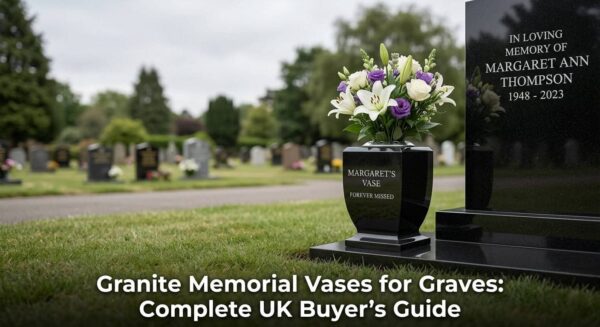
Polished black granite, the most widely specified for UK cemeteries, is typically produced from Shanxi Black granite, a high-density stone with an exceptionally tight mineral structure, very low porosity, and strong resistance to acid and alkali. Its deep, consistent colour holds well outdoors without fading.
Polished grey granite is a softer, more understated option often chosen for lawn memorials plaques and traditional churchyard settings where the neutral tone integrates well with surrounding stone and landscape.
Balmoral Red granite is distinctive warm red-brown Scottish stone is commonly used for headstones across the UK, making it a natural choice for a matching grave vase when builders have used the same material for the existing memorial.
Bahama Blue and other premium granites in the range offer a more striking, individual appearance for families whose headstone already features these colours or who want a grave vase that stands distinctly from standard cemetery decoration.
When choosing a granite colour for a memorial vase, the most important principle is to work from the existing headstone outward. A grave vase that exactly matches, or deliberately contrasts with, the headstone granite creates a composed, intentional memorial rather than a disconnected collection of elements. A qualified monumental mason or specialist memorial supplier will be able to advise on colour matching from a headstone sample or photograph.
Granite memorial vases for graves are available in a range of forms, each suited to different headstone types and personal preferences.
Cube or block-shaped vases in 6×6×6-inch or 7×7×7-inch dimensions are the most common in UK cemeteries, offering a generous flower-holding capacity, a stable base footprint, and sufficient flat surface area for engraving on one or more faces.
Turned or cylindrical vases are produced on a lathe, giving a smooth, rounded profile that reads more decoratively than a cube. The turned form works well alongside round-topped headstones and more traditional memorial designs.
Rosebowl vases have a wider opening relative to their body depth, accommodating larger floral arrangements and lending a softer, more domestic appearance to the graveside.
Tapered side designs offer a contemporary aesthetic, narrowing toward the base for a clean, proportioned look against modern flat or slant-top headstones.
For families wanting to place vases on both sides of a headstone, twin sets in matched granite and size are the appropriate choice. Placed symmetrically on either side of the headstone base a matched pair creates a balanced, purposeful memorial arrangement.
All of these forms are available with a removable metal insert, typically in aluminium, that sits inside the vase body and holds cut stems or artificial flowers without allowing water to stagnate against the stone interior.
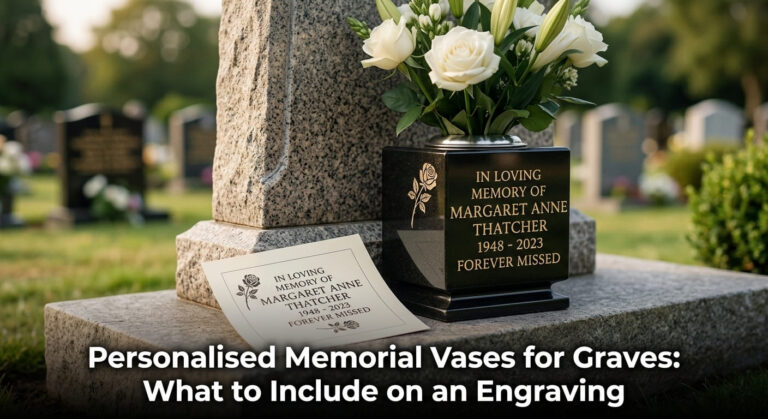
The majority of families who purchase a granite grave vase in the UK choose to have it personalised. The most common engravings include the name of the deceased, significant dates, a short verse or dedication, and symbolic motifs such as a rose, dove, praying hands, angel, or cross.
Sandblast engraving cuts into the granite surface under pressure, creating a three-dimensional incised letter or image. The depth of cut makes it inherently durable outdoors, and the carved channels are subsequently painted by hand with outdoor enamel in the family’s chosen colour, traditionally gold leaf, silver, white, or black.
Laser engraving produces a precise, crisp finish using computer-controlled beam technology. It is particularly well-suited to fine detail, photographic imagery, and complex motifs where hand-cutting would struggle with resolution.
In both cases, reputable UK suppliers will issue a digital proof image showing the exact layout, font, and inscription content for the buyer’s written approval before any cutting begins. This step protects against spelling errors and layout mismatches that cannot be corrected once engraving is complete. Always review your proof carefully, check all names, dates, and punctuation before approving.
The method of installation depends on whether the vase is to be permanently fixed or freestanding.
Freestanding placement is the simplest option. A granite vase of sufficient weight (4 kg or more) placed on a firm, level surface beside or at the base of a headstone will remain stable in typical UK wind conditions without fixings. Checking that the ground is level and that the vase is clear of the mowing line matters for long-term stability.
Adhesive fixing to a polished granite headstone requires an epoxy specifically formulated for granite-to-granite bonding, as standard mastic glue does not achieve adequate adhesion on polished stone. The surface must be clean and dry before application. Apply epoxy to the base of the vase, position carefully, press firmly to distribute the adhesive evenly, and secure with tape for up to 24 hours while curing. A frost-resistant silicone sealant is an alternative used by some stonemasons where the climate is particularly harsh.
Anchor bolt fixing to a concrete base is the most secure permanent installation method, used by memorial masons when fitting granite vases to an existing kerb set or headstone base as part of a cemetery-approved installation.
Before purchasing or installing any granite memorial vase, confirming the relevant cemetery’s regulations is essential. In the UK, a variety of authorities, including local councils, the Church of England, private operators, and religious organisations, manage burial grounds, each maintaining their own rules on memorial accessories.
Common regulations cover maximum vase dimensions, approved materials (most UK cemeteries accept polished granite without question, making it a reliable choice), rules on permanent fixing versus freestanding placement, and whether you need a formal application and permit before installation.
Where a granite vase is to be permanently attached to an existing headstone, the family holding the deed of grant for the plot is responsible for obtaining permission from the burial authority. In many cases, a stonemason submits this application on the family’s behalf as part of the installation service.
Granite memorial vases are among the most widely accepted accessories in UK cemeteries and churchyards because the material offers a dignified appearance and requires no maintenance from the cemetery operator. Always confirm with your specific cemetery first, particularly for cremation plots and gardens of remembrance, where space restrictions and styling guidelines may be more specific
Granite requires minimal maintenance, but a periodic clean extends the life of polished surfaces and engraved lettering. The correct method for cleaning a granite grave vase is straightforward: warm water, a mild non-ionic soap or specialist stone cleaner, and a soft cloth or natural-bristle brush. This combination safely removes hard water deposits, surface soil, and early biological growth without damaging the stone or the enamel lettering infill.
What to avoid is equally important. Never use household bleach, ammonia, vinegar, or lemon-based cleaners on granite. These acids and alkalis react with the minerals in the stone, causing microscopic surface damage that accelerates biological growth and dulls the polished finish over time. If lichen or moss has established itself on the surface, use a specialist headstone cleaner formulated for natural stone. Always check with your burial authority before applying any product, as some heritage cemeteries restrict what they allow on stone surfaces.
Inspect the drainage hole in the vase base at least once annually. If standing water cannot drain freely during winter, it can freeze and expand inside the vase body, causing internal cracking even in a material as durable as granite.
At Signs and Memorials, all granite cemetery vases in the range are supplied with care and cleaning guidance specific to the finish and engraving method used, a practical resource that most general suppliers do not provide.
Granite grave vases span a wide price range depending on size, colour, and personalisation. Plain, smaller granite vases in standard black or grey start from approximately £50–£80. Mid-sized engraved options with a single-face inscription and standard infill typically range from £150 to £250. Larger, fully personalised pieces in premium granite colours such as Balmoral Red, with sandblast engraving, gold infill, and matching bases, can exceed £500.
Personalised items require a production lead time of approximately two to three weeks from approved proof to dispatch, so you should factor this into your planning, particularly around significant memorial dates.
Signs and Memorials offers personalised grave vases at competitive pricing across the full range described above, with UK-wide delivery and expert guidance on colour matching, engraving, and cemetery compliance for every order. Browse the current range or contact the team to discuss a bespoke commission at signsandmemorials.co.uk.
A polished granite memorial vase can last several decades to centuries in UK outdoor conditions. Its igneous rock structure is freeze-thaw resistant, does not corrode or fade, and rates 6–7 on the Mohs hardness scale. Minimal maintenance, a periodic clean with non-ionic soap, is all that is required.
Yes. Granite grave vases can be engraved using sandblast or laser techniques, with lettering infilled in gold, silver, white, or black enamel paint. A proof image is provided for approval before cutting begins. Reputable UK suppliers, including Signs and Memorials, offer personalised engraving with no restriction on the number of characters.
The most common UK sizes are 6×6×6 inches and 7×7×7 inches. A 6-inch cube suits single flowers or small seasonal arrangements; a 7-inch cube accommodates larger bouquets. Twin sets placed either side of a headstone use the same size for both. Size should be proportional to the headstone, your cemetery may also specify maximum dimensions.
Yes. The vast majority of UK cemeteries and churchyards accept polished granite memorial vases as a standard memorial material. Regulations on size, permanent fixing, and permit requirements vary by burial authority. Always confirm with your cemetery before purchasing, particularly for cremation plots and gardens of remembrance with specific styling guidelines.
You can fix a granite vase to a polished granite headstone using a granite-specific epoxy adhesive. Standard mastic glue does not adhere well to polished stone. Clean and dry the surface first, apply epoxy to the vase base, position carefully, and secure with tape for 24 hours. A stonemason uses an anchor bolt fixed into a concrete base for permanent installations.
UK cemeteries most commonly use polished black granite, often Shanxi Black. Because it offers a deep colour, tight mineral structure, and strong resistance to weathering. To create a composed memorial, choose a colour that matches or deliberately complements the existing headstone granite. Signs and Memorials can advise on colour matching from a headstone photograph or sample reference.
Clean a granite grave vase using warm water, a mild non-ionic soap, and a soft cloth or brush. Never use bleach, ammonia, vinegar, or acid-based cleaners, these damage the polished surface and enamel lettering over time. Remove hard water deposits gently with a damp cloth. Check and clear the drainage hole at the base before winter to prevent freeze damage.
share this post:
